
Primary Antibody Matched Pairs

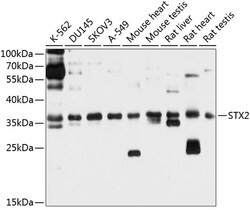
ABclonal Technology STX2 Rabbit pAb

The product of this gene belongs to the syntaxin/epimorphin family of proteins. The syntaxins are a large protein family implicated in the targeting and fusion of intracellular transport vesicles. The product of this gene regulates epithelial-mesenchymal interactions and epithelial cell morphogenesis and activation. Alternatively spliced transcript variants encoding different isoforms have been identified.


Genscript Corporation CD55 His Human
Decay Accelerating Factor (or CD55) is a major regulator of the alternative and classical pathways of complement activation and is expressed on all serum-exposed cells It is commonly hijacked by invading pathogens including many enteroviruses and uropathogenic Escherichia coli to promote cellular attachment prior to infection


Biotium PLAP (Placental Alkaline Phosphatase)(ALPP/238), CF740 conjugate, 0.1mg/mL
PLAP is a tissue specific, trophoblast-derived, 70 kDa, glycosyl-phosphatidylinositol (GPI)-anchored, dimeric, Zn2 metallo glycoprotein that catalyzes the hydrolysis of phosphomonoesters into an inorganic phosphate and an alcohol. It is present in the placenta and serum of pregnant women and in high frequency in gynecological and testicular cancers and in lower frequency in other tumors. The three tissue-specific AP's in humans, PLAP, germ cell AP (GCAP) and intestinal AP, are 90-98% homologous. Non-tissue specific AP is found in kidney, liver and bone. This MAb binds equally well to all common allelic variants (S, F, FS and I) of PLAP as to AP from normal human testis. This MAb can be used both as coating as well as tracer antibody in the same ELISA to detect PLAP in serum of S, F, FS and I phenotypes.Primary antibodies are available purified, or with a selection of fluorescent CF Dyes and other labels. CF Dyes offer exceptional brightness and photostability. Note: Conju
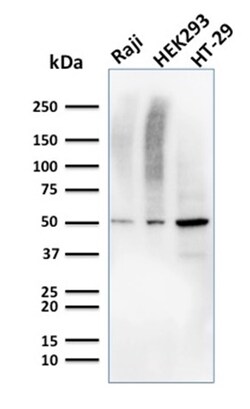
Biotium MMP3 (Marker of Metastasis and Rheumatoid Arthritis)(MMP3/2655), 0.2mg/mL
The matrix metalloproteinases (MMP) are a family of peptidase enzymes responsible for the degradation of extracellular matrix components, including collagen, gelatin, fibronectin, laminin and proteoglycan. Transcription of MMP genes is differentially activated by phorbol ester, lipopolysaccharide (LPS) or staphylococcal enterotoxin B (SEB). MMP catalysis requires both calcium and zinc. MMP-3, MMP-10 and MMP-11 (also designated stromelysin-1, 2 and 3, respectively) activate procollagenase. MMP-3 activation of procollagenase can occur via two pathways. Direct activation by MMP-3 is slow and activation by MMP-3 in conjunction with tissue or plasma proteinases is rapid. MMP-10 is expressed in small intestine, and at lower levels in lung and heart. MMP-11 is specifically expressed in stromal cells of breast carcinomas and contributes to epithelial cell malignancies. Primary antibodies are available purified, or with a selection of fluorescent CF Dyes and other labels. CF Dyes of
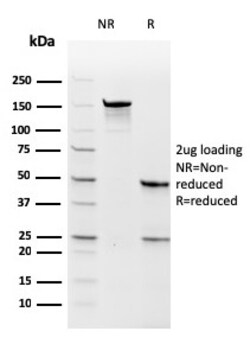
Biotium Thymidylate Synthase (5-FU Resistance Marker)(rTYMS/1884), CF405S conjugate, 0.1mg/mL
Recognizes a protein of 36 kDa, identified as Thymidylate Synthase (TS) (EC 2. 1. 1. 45). It converts deoxyuridine monophosphate (dUMP) to deoxythymidine monophosphate (dTMP), which is essential for DNA biosynthesis. TS is also a critical target for the fluoropyrimidines, an important group of antineoplastic drugs that are widely used in the treatment of solid tumors. Both 5-FU and fluorodeoxyuridine are converted in tumor cells to FdUMP which inactivates TS by formation of a ternary covalent complex in the presence of the folate cofactor 5, 10-methylenetetrahydrofolate. Expression of TS protein has been reported to associate with response to 5-fluorouracil (5-FU) in human colorectal, gastric, head and neck, and breast carcinomas. Primary antibodies are available purified, or with a selection of fluorescent CF Dyes and other labels. CF Dyes offer exceptional brightness and photostability. Note: Conjugates of blue fluorescent dyes like CF405S and CF405M are not recommende
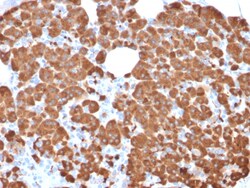
Biotium Carboxypeptidase A1 / CPA1 (Pancreatic Cancer Marker)(CPA1/2711), CF740 conjugate, 0.1mg/mL
Carboxypeptidase A1 (CPA1) is a secreted zinc metalloprotease that is highly expressed in pancreatic tissue. It catalyzes the release of C-terminal amino acids from a variety of proteins, thereby playing a key role in protein digestion and degradation. Human pancreatic procarboxypeptidase A exists as three different active forms, two of which are carboxypeptidase A1 (CPA1) and carboxypeptidase A2 (CPA2). Abnormal levels of CPA1 are associated with pancreatic cancer, suggesting a possible role in either tumor progression or tumor suppression events. Primary antibodies are available purified, or with a selection of fluorescent CF Dyes and other labels. CF Dyes offer exceptional brightness and photostability. Note: Conjugates of blue fluorescent dyes like CF405S and CF405M are not recommended for detecting low abundance targets, because blue dyes have lower fluorescence and can give higher non-specific background than other dye colors.
Biotium CD209 / DC-SIGN (Pathogen Receptor on Dendritic Cells)(C209/2749R), CF594 conjugate, 0.1mg/mL
DC-SIGN is a transmembrane receptor that is expressed on the surface of dendritic cells and macrophages. It is involved in the innate immune system and recognizes numerous evolutionarily divergent pathogens ranging from parasites to viruses. The protein is organized into three distinct domains: an N-terminal transmembrane domain, a tandem-repeat neck domain and C-type lectin carbohydrate recognition domain. The extracellular region consisting of the C-type lectin and neck domains has a dual function as a pathogen recognition receptor and a cell adhesion receptor by binding carbohydrate ligands on the surface of microbes and endogenous cells. The neck region is important for homo-oligomerization, which allows the receptor to bind multivalent ligands with high avidity. Primary antibodies are available purified, or with a selection of fluorescent CF Dyes and other labels. CF Dyes offer exceptional brightness and photostability. Note: Conjugates of blue fluorescent dyes like C
Sino Biological Recombinant Rat Interferon alpha 1/IFNA1 Protein (His Tag) 20
A DNA sequence encoding the rat IFNA1 (P05011) (Met1-Ser192) was expressed, fused with a polyhistidine tag at the C-terminus.
American Research Products Inc AMERICAN RESEARCH PRODUCTS INC
5000611644 HUMAN FCN2/FICOLIN-2 ELISA KIT
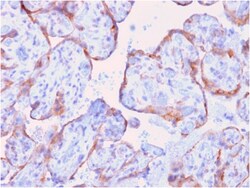
Biotium MMP3 (Marker of Metastasis and Rheumatoid Arthritis)(rMMP3/1730), CF740 conjugate, 0.1mg/mL
The matrix metalloproteinases (MMP) are a family of peptidase enzymes responsible for the degradation of extracellular matrix components, including collagen, gelatin, fibronectin, laminin and proteoglycan. Transcription of MMP genes is differentially activated by phorbol ester, lipopolysaccharide (LPS) or staphylococcal enterotoxin B (SEB). MMP catalysis requires both calcium and zinc. MMP-3, MMP-10 and MMP-11 (also designated stromelysin-1, 2 and 3, respectively) activate procollagenase. MMP-3 activation of procollagenase can occur via two pathways. Direct activation by MMP-3 is slow and activation by MMP-3 in conjunction with tissue or plasma proteinases is rapid. MMP-10 is expressed in small intestine, and at lower levels in lung and heart. MMP-11 is specifically expressed in stromal cells of breast carcinomas and contributes to epithelial cell malignancies. Primary antibodies are available purified, or with a selection of fluorescent CF Dyes and other labels. CF Dyes offer e

Influenza B NP ELISA Pair Set 5PP (Sino Biological)
Each vial contains 210 ng of recombinant Influenza B (B/Florida/4/2006) Nucleoprotein / NP. Reconstitute with 1 mL dilution buffer. After reconstitution, store at -20℃ to -80℃ in a manual defrost freezer. A seven-point standard curve using 2-fold serial dilutions in dilution buffer, and a high standard of 8000 pg/mL is recommended.

Biotium CD56 / NCAM1 / NKH1 (Neuronal Cell Marker) (NCAM1/1496), CF488A conjugate, 0.1mg/mL
This MAb reacts with an extracellular domain (close to transmembrane) of CD56/NCAM. Three isoforms of neural cell adhesion molecule (NCAM) are produced by differential splicing of the RNA transcript from a single gene. The 135 kDa isoform is the basic molecule, which is glycosylated or sialylated to produce the mature species. Anti-CD56 recognizes two proteins of the neural cell adhesion molecule, the basic molecule expressed on most neuroectodermally derived tissues and neoplasms (e.g. retinoblastoma, medulloblastomas, astrocytomas, neuroblastomas, and small cell carcinomas). It is also expressed on some mesodermally derived tumors (rhabdomyosarcoma). Anti-CD56 plays an important role in the diagnosis of nodal and nasal NK/T-cell lymphomas.Primary antibodies are available purified, or with a selection of fluorescent CF Dyes and other labels. CF Dyes offer exceptional brightness and photostability. Note: Conjugates of blue fluorescent dyes like CF405S and CF405M are not
Genscript Corporation FGL1 Fc Chimera Human
FGL1 (Fibrinogen-like protein 1) also known as hepatocyte-derived fibrinogen-related protein 1 (HFREP-1) HP-041 hepassocin (HPS) and liver fibrinogen-related protein 1 (LFIRE-1) is a liver-specific secreted protein belonging to the fibrinogen superfamily whose members share a fibrinogen domain at their C-termini FGL1 is an immune suppressive molecule that inhibits the activation of antigen-specific T cells by acting as a major ligand of LAG3 and binds LAG3 independently of MHC class II
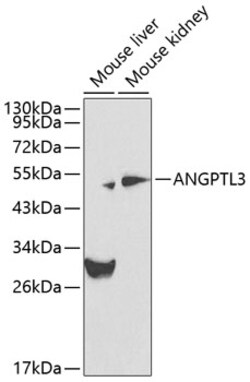
ABclonal Technology ANGPTL3 Rabbit pAb
This gene encodes a member of a family of secreted proteins that function in angiogenesis. The encoded protein, which is expressed predominantly in the liver, is further processed into an N-terminal coiled-coil domain-containing chain and a C-terminal fibrinogen chain. The N-terminal chain is important for lipid metabolism, while the C-terminal chain may be involved in angiogenesis. Mutations in this gene cause familial hypobetalipoproteinemia type 2.

Medchemexpress LLC S100A8-S100A9 Hetero 50ug
Recombinant human S100A8-S100A9 heterodimer protein supplied as a purified solution with a C-terminal His tag. Produced by coexpression in E. coli and purified to >95% purity, the heterodimer (calprotectin) is suitable for biochemical and cell-based assays investigating inflammation, immune signaling, and metal-binding activity.
- High purity (>95%) suitable for analytical and functional studies.
- C-terminal 6xHis tag for affinity purification and detection.
- Expressed in Escherichia coli for scalable production.
- Available in multiple sizes including 50 μg for small-scale assays.
- Contains human S100A8 and S100A9 sequences (UniProt P05109, P06702).